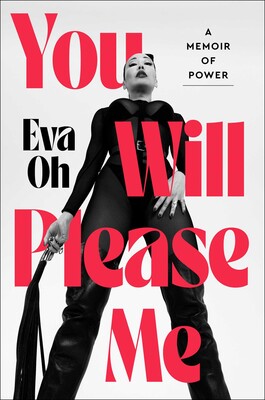
“She Asks the Question the Rest of Us Avoid: Who Are You When No One Is Directing?”
The question arrives before the book does. Who might we become when no one is telling us who to be? When does surrender become an act of agency?
Eva Oh has spent years on the other side of that question. Readers of Kink Queens Magazine already know her face from the cover of Issue 15, where she appeared as Cover Domme. In YOU WILL PLEASE ME: A Memoir of Power, the cultural provocateur, sex educator, and Sexual Freedom Award recipient opens the dungeon door not as spectacle but as laboratory. The book, arriving from Gallery Books in May 2027, treats professional domination as both craft and X-ray: a place where the unwritten rules about who gets to want, who gets to decide, and who is expected to please become suddenly, sometimes brutally, visible.
Oh does not frame her work as therapy, though high-performing men often arrive as if it were. CEOs, financiers, and others accustomed to control pay her $1,000 an hour—or, in one case, $325,000 a year—to relinquish it. What they seek is not simply the performance of submission but the temporary relief of its burden. Humiliation kink, in her telling, becomes a sanctioned space for emotions that success has rendered forbidden: the freedom to fail, to be ordinary, to be less than the story the world requires them to star in. The dungeon does not invent those needs; it names them.
A simple exercise she gives new submissives makes the point outside any scene. She has them walk. Nothing more. The instruction is ordinary enough that the resistance it produces is revealing. Who shortens their stride. Who apologizes for taking up space. Who waits for permission they were never denied. Power, Oh suggests, is less a possession than a continuous negotiation of expectation, and most of us are fluent in its grammar long before we enter a play space. The memoir tracks those negotiations across contexts: inside the dungeon, in corporate rooms she once occupied, in the private calculus of a relationship in which she temporarily set her own livelihood aside.
That last chapter is not presented as cautionary tale so much as data. Oh left a corporate career to pursue domination full-time. Years later, far from home and in an unfulfilling relationship, she found herself again arranging her life around someone else’s needs. The recovery she describes is deliberate rather than dramatic: meditation, a year of abstinence, tea ceremonies, and a return to the work itself. Agency, in this account, is not a permanent condition but a practice that can be interrupted and then resumed. The same woman who can hold a room of high-status men can also misplace herself. The book refuses to treat those facts as contradictions.
The economics of the work receive similar scrutiny. Oh built YouWillPleaseMe.com as an educational platform that gamifies training for people who cannot afford her hourly rate, expanding access while protecting the scarcity that underwrites her private practice. She is frank about the larger market: sex work remains one of the few fields in which women consistently outearn men, and it remains heavily stigmatized for exactly that reason. Modern anti-sex-work laws, she argues, frequently endanger the people they claim to protect. Pricing her company, she writes, was less a branding exercise than an education in her own worth; once the number existed, the quality of the men who sought her improved. Money clarified the transaction and, in doing so, clarified the power.
 Her background supplies additional layers rather than origin myth. Multicultural heritage, UN work, and time in Afghanistan shaped a worldview in which power is never abstract. She learned from women in her family and in the industry, traveled, studied, and eventually trained other dominatrixes. A visit to a Berlin dungeon as a client produced one of the memoir’s sharper revelations about the difference between directing and receiving a scene. Dating as a woman over forty appears not as subplot but as parallel laboratory: another arena in which desire, value, and autonomy are continuously renegotiated. For a closer look at how she discusses these ideas, watch her interview here.
Outside the dungeon, Oh’s nonprofit work with refugees and asylum seekers continues a different form of attention. Clients, at her suggestion, have directed significant sums toward causes; the principle is that changing one mind at a time can still move resources. She treats this less as redemption narrative than as consistent practice. Prioritizing others’ needs, she notes, is not the opposite of dominance; in certain contexts it is one of its expressions.
YOU WILL PLEASE ME does not promise that professional domination will resolve anyone’s contradictions. It offers something narrower and more useful: a detailed account of what becomes visible when power is deliberately, temporarily, and consensually rearranged. The public life and the private desire are not separate domains. They are written in the same language. Oh’s contribution is to make the grammar legible.
For readers who already live inside kink communities, the memoir’s value may lie less in revelation than in precision. For everyone else, it poses the same questions the work itself keeps asking: What do we protect when we refuse to surrender? What do we discover when we do? And who, exactly, is writing the rules we claim to be following?
YOU WILL PLEASE ME: A Memoir of Power by Eva Oh will be published by Gallery Books on May 11, 2027. Pre-order or learn more here. Oh hosts the You Will Please Me podcast and maintains a substantial public presence as educator and advocate.